Who Will Build It? The Missing Question in the Race to Build Beyond Earth

By Norm Levy
Author of Band on the Run

We are watching something extraordinary unfold in real time.

Not long ago, space felt distant again, reserved for rare launches and symbolic milestones. Today, it feels active. Continuous. Almost industrial. Rockets lift off with increasing frequency, and more remarkably, they return. What once disappeared into the sky now lands back on Earth with precision, ready to fly again. Reusability has changed the economics, and with it, the pace.

Programs like NASA Artemis are pushing humanity back toward the Moon with long-term intent, not just flags and footprints, but infrastructure. At the same time, private industry is accelerating timelines and reframing space not as exploration alone, but as extension.

This is no longer just about going to space.

It is about building in space.

At the same time, other forces are converging in ways that feel impossible to ignore. Artificial intelligence is driving an unprecedented demand for compute. Data centers are expanding at a pace that is already straining power grids, land availability, and cooling systems here on Earth. Some of the most serious conversations in infrastructure today are no longer about optimization, but relocation.

There is now credible discussion around placing data centers in orbit, powered by uninterrupted solar energy, free from terrestrial constraints. What once sounded speculative is now being modeled, financed, and quietly engineered.

Energy is becoming the currency. Compute is becoming the engine. And space is becoming the release valve.

Alongside this, the economics of materials are shifting. Rare metals essential to modern life—cobalt, platinum, palladium—are increasingly difficult and expensive to extract on Earth. Meanwhile, asteroids rich in these exact resources exist in staggering abundance just beyond our atmosphere.

For decades, this was theory.

Now, it is strategy.

At the same time, zero gravity introduces entirely new possibilities for manufacturing. Processes that are inefficient or impossible on Earth become not only feasible, but optimal. Advanced materials, pharmaceuticals, precision fabrication—all benefit from an environment where gravity is no longer a constraint.

Taken together, these shifts point to something much larger than exploration.

We are preparing, in real terms, to industrialize space.

And yet, beneath all of this momentum, there is a question almost no one is asking.

Not who gets to go. Not who gets to explore.

Who will build it?

Because space will not be built by astronauts.

Astronauts will lead. They will explore. They will inspire. But they will not construct the infrastructure required for humanity to live and work beyond Earth at scale.

That will take workers.

Builders. Operators. Technicians.

Not dozens. Not hundreds.

Thousands.

Eventually, tens of thousands.

There was a moment in a recent fictional interview I wrote, where a visionary architect of this future was asked directly where that workforce would come from. His answer was calm, almost effortless. Cities are overwhelmed. Systems are strained. People are looking for structure, for opportunity, for a second chance. Take those at the margins, he suggested, and give them purpose inside something bigger.

It was framed as a solution.

And that is where the question becomes harder to ignore.

Because history offers a pattern.

New worlds are not built by visionaries alone. They are built by those with fewer options. The displaced. The overlooked. The ones willing, or compelled, to step into uncertainty because the alternative offers less.

In another era, people stood at a very different kind of threshold, facing impossible choices. Stay and struggle, or leave and build something unknown. The result was the foundation of entirely new societies, built not just on ambition, but on necessity.

That pattern is not ancient history.

It is human nature.

And as we stand at the edge of a new frontier, it is worth asking whether anything fundamental about that pattern has changed.

Because building a world is not the same as visiting one.

It is slower. Harder. Less visible. It requires endurance, repetition, and scale. It requires people willing to do the work long after the cameras have turned away.

None of this diminishes what is happening today.

If anything, it makes it more real.

More grounded.

More consequential.

Because once the technology works, once the economics align, once the pathways between Earth and orbit become routine, the bottleneck will shift.

It will no longer be whether we can build beyond Earth.

It will be whether we have the workforce to do it.

And how that workforce is found, incentivized, or compelled.

That question has stayed with me for a long time.

It sits quietly beneath every launch, every breakthrough, every announcement about the future of life beyond Earth.

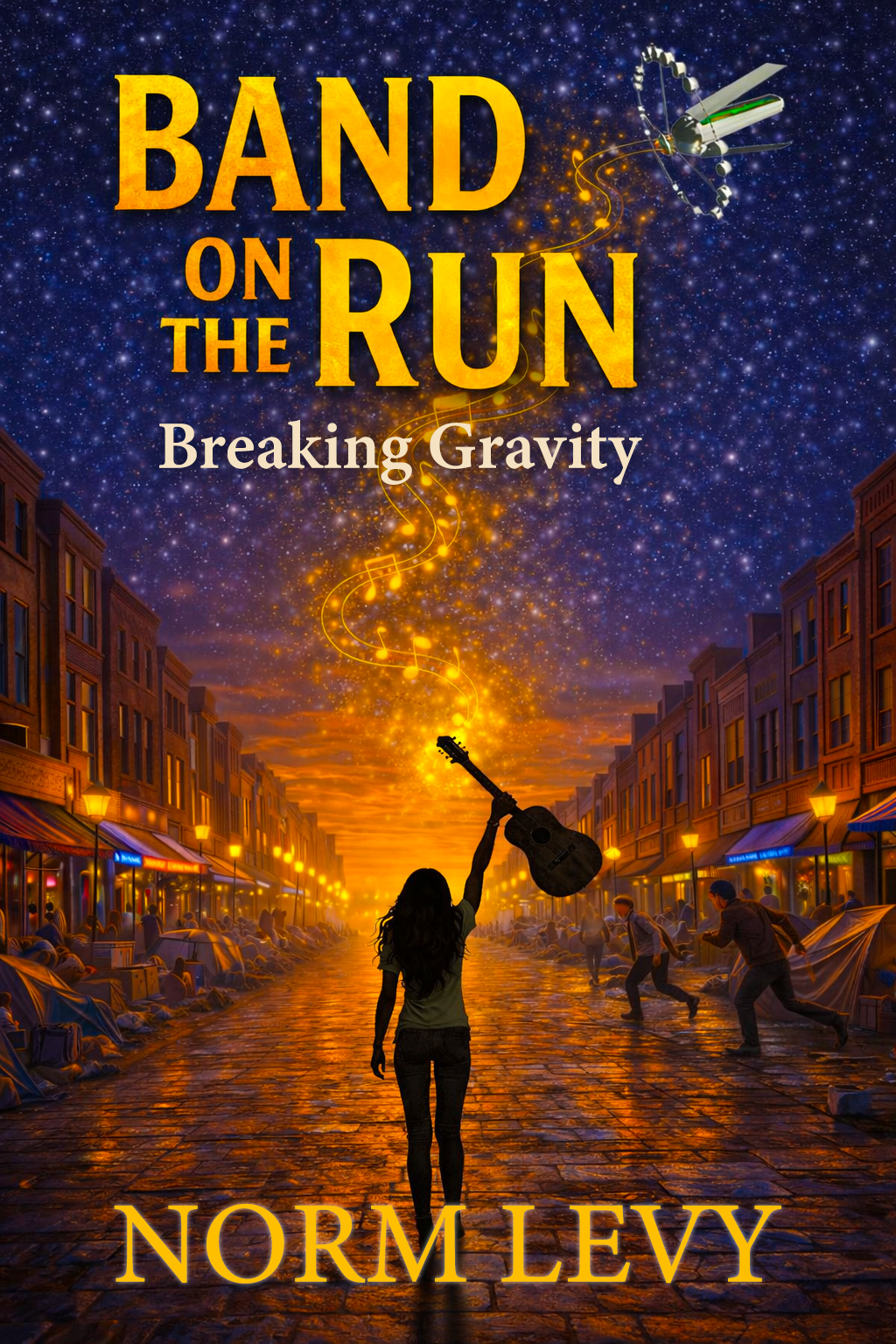
It is, in many ways, the reason I began writing Band on the Run.

Not as a prediction. Not as a warning.

But as a story built around a simple, uncomfortable idea:

The future isn’t just something we imagine.

It’s something someone has to build.

Feels like we’re asking all the right questions about how to get there.


Not sure we’re asking enough about what happens after we do.

Would love to hear how others are thinking about that.


Writing more about this at bandonthe.run for anyone interested.

Rebels, Rhythm, and Zero-Gravity: The Story Behind Band on the Run (Coming Soon!)

What happens when you take a street-smart teenage musician, throw her into a high-stakes chase across Memphis, imprison her in a castle, and launch her into the depths of space? You get Band on the Run, a groundbreaking Young Adult epic where music ignites rebellion, freedom is forged in high orbit, and one girl’s voice becomes a revolution.

Written by entertainment industry veteran Norm Levy, who has worked on major motion pictures at Grumman Studios and across TV, film, and music, Band on the Run is a pulse-pounding blend of heart, grit, and rhythm, from the backstreets of Memphis to the stars above.

At its heart is sixteen-year-old Jenny Brown, a fearless, street-smart musician fighting to survive and to reach her lost little brother, Dak. With her band of runaways, she invents a raw, soul-charged sound called Blues-Bop, turning survival into art and street corners into stages. But when the city enforces a new Salvation Law that sweeps homeless kids off the streets, Jenny and her band are captured and shipped to H.O.M.E. (High Orbit Manufacturing Enterprise), where they are indentured to a billionaire whose dream of building the future hides a ruthless quest to become the world’s first trillionaire, mining asteroids for rare metals.

Armed with nothing but their music, courage, and defiance, Jenny and her crew transform their songs into a spark of rebellion that could unite the counter-rotating habitats of H.O.M.E., upend the system, and change the fate of humanity itself.

More than a story, Band on the Run is the spark—a cultural catalyst meant to inspire a new generation to look beyond Earth, break free from gravity’s hold, and imagine a future where millions, even billions, could one day live, work, and thrive beyond our thin biosphere. Inspired by the visionary ideas of physicist Gerard K. O’Neill, it pays homage to his stellar blueprint for humanity’s expansion into space—self-sustaining worlds powered by innovation, industry, and imagination—and carries forward his boundless vision of expanding ever outward into the stars to secure humanity’s place in the universe.

Blending relentless action, raw emotion, and an original twelve-song soundtrack, Band on the Run is where The Hunger Games meets A Star Is Born in zero-gravity, a world of rebellion, rhythm, and the fight for freedom among the stars. It’s a franchise-ready adventure destined for the page, screen, stage, and even the amusement park—complete with zero-G games, thrilling challenges, and gravity-defying concerts, driven by revolutionary spirit and a voice that refuses to fade.

The stakes are astronomical.
The rhythm is unstoppable.
And the fight for freedom? It has only just begun.

Are you ready to run? 🚀🎸

“The horizon is not behind us, nor ahead—it is above. And those brave enough to rise will find a future brighter than any dawn.” 
Miles Wentworth – H.O.M.E. (High Orbit Manufacturing Enterprise), Founder and CEO 

#BandOnTheRun #YAfiction  #NoPlaceLikeHOME #GalacticConcertEvent